In university, you will have to write lots of assignments on different topics. But writing a good academic paper is not just about hitting the word count. A quality assignment will include ideas that are clearly communicated, evidence that is reliable, a logical order, and critical thinking. In particular, if you have any difficulties organising your thoughts or have no idea what your lecturer wants, it can make a world of difference to have good writing skills.
But there is some good news to this: assignment writing is a skill that can be learned. Don't strive to be a flawless writer immediately. With a little practice, you'll be more confident and be able to create better assignments.
Tips to Improve Assignment Writing Skills
These tips are tried and tested and can help you enhance your overall assignment writing skills:
1. Understand the Assignment Question
One of the simplest ways to make your assignment better is to be sure you answer the question correctly. Read the assignment brief carefully prior to researching or writing.
Be aware of verbs that call for analysis, discussion, evaluation, comparison, explanation and critical assessment, for example. These are the words that will give you an idea of the things your lecturer expects you to do.
For instance, if you are asked an essay question about the evaluation of a theory, you need to go beyond a mere explanation of the theory. It's important to take into account its strengths and weaknesses, supporting evidence, and limitations.
2. Improve Your Research Skills
Good assignments are typically well researched. Avoid the first websites you come across from a search engine; try to find reputable scholarly sources. According to a study, 50% of these pages fail to deliver the right experience.
These are some useful sources:
● Peer-reviewed journal articles
● Academic books
● Government publications
● University resources
● Research reports
● Official organisational websites
While doing your research, take notes in your own words and note the information about each source. This will help you to reference it later, and you won't risk copying the wrong information.
3. Develop A Writing Plan
If an assignment is not done on a plan, it may result in repetition, weak arguments and disjointed paragraphs.
Make an outline before writing the first draft. Make a plan for your introduction, body and conclusion.
For instance, a plan could be:
Introduction: Introduce the topic and main argument.
Paragraphs 1 & 2: Summarise the first point.
Paragraph 2: Give evidence and analysis.
Paragraph 3: Talk about a different point of view.
Paragraph 4: Critically assess the key points.
Conclusion: Read through the discussion and answer the question (summarise).
Plans don't have to be complicated. A brief outline can provide your writing with a definite direction.
4. Strengthen Your Academic Vocabulary
Academic writing doesn't imply the use of complex words in all sentences. Actually, the more cumbersome your vocabulary turns out to be, the more difficult you make your ideas for your audience to grasp.
Rather, practice the use of precise and appropriate language. Understand and know common academic vocabulary associated with a particular topic.
5. Focus on Critical Thinking
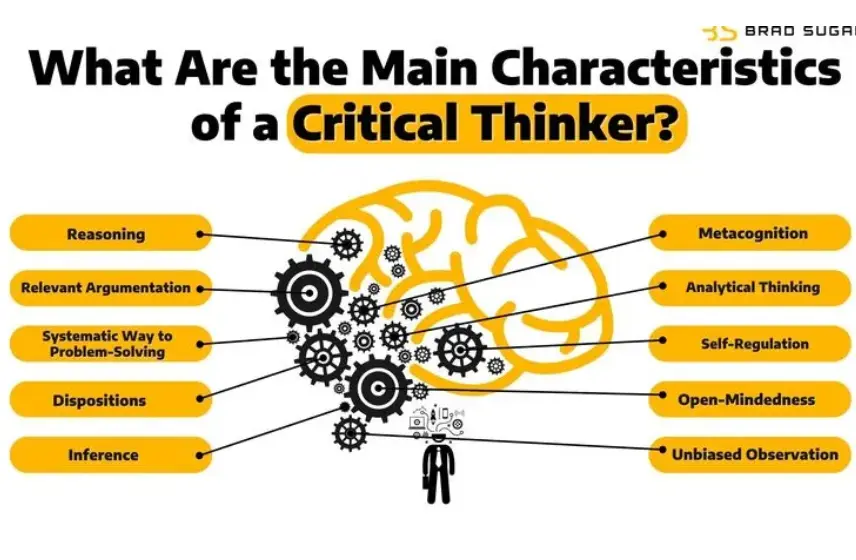
Source: https://bradsugars.com/critical-thinking-skills/
The most significant variance between simple and good college essays is the amount of analysis.
Just stating what a researcher or theory says is not enough. It is important to think about the relevance of the information and how it relates to your argument.
Ask questions such as:
● What does this evidence show?
● Would the information be accurate if it were true?
● What are some of the restrictions in this argument?
● Do the other researchers agree?
● What do the implications mean?
● How is this answer linked to the question of the assignment?
Use these questions to go from 'description' to 'analysis' and 'show deeper understanding'.
6. Write Strong Paragraphs
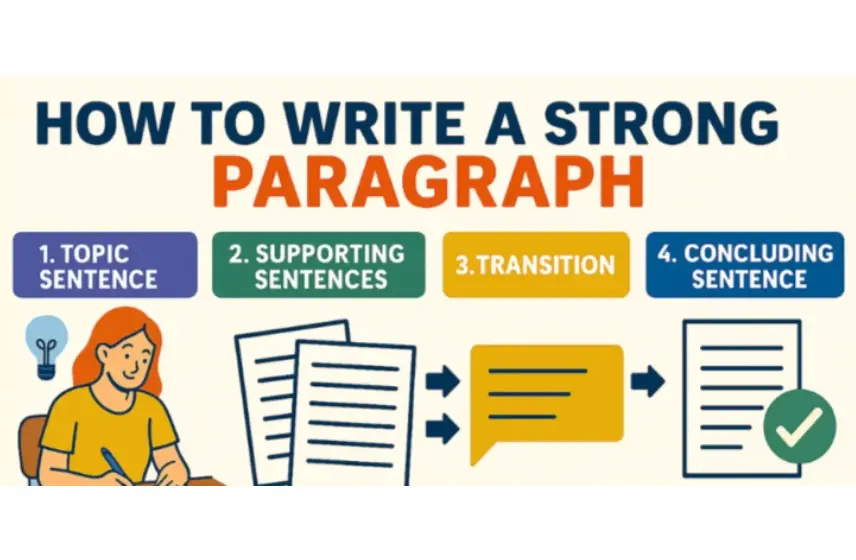
Source: https://grammarinsights.com/writing-tips/how-to-write-strong-paragraphs/#google_vignette
All paragraphs must have a clear purpose. A good way to write an outline is to start with a topic sentence and then add supporting evidence and explanation.
For example:
Point → Evidence → Analysis → Link
Avoid putting a quotation in a paragraph without a word of explanation. Interpret the meaning of the quotation and how it backs up your argument.
Well-written paragraphs should also link together nicely. Introduce and connect ideas with suitable linking words/phrases to establish the relationship between words and ideas and make the text flow.
7. Use Evidence Properly
Evidence can support your argument; however, it can only do so when it is relevant and well-explained.
Do not include too many long quotes in your research-based assignment. Restating information in your own words can sometimes help the writing be more fluid.
But paraphrasing does not involve altering just a few words from the original sentence. You need to be aware of your source, and state your idea in your own words as well as cite your source.
Referencing should always be in the referencing system that your university requires - Harvard, APA, MLA or another referencing system.
8. Improve Your Time Management
If you are not using your time well, it will impact your writing. Assignments that are given to students at the last minute are difficult for the student to research, write, edit, and proofread.
Divide the task into smaller parts:
- Understand the brief.
- Research the topic.
- Organise your notes.
- Create an outline.
- Write the first draft.
- Edit and revise.
- Proofread and check references.
- Hand in the final copy.
Taking breaks between stages can help defuse the stress. If your deadlines are approaching, it is always a smart option to hire assignment help Sydney to assist you and ensure timely submission.
9. Revise First Draft
Your initial draft doesn't need to be without fault. After completing your writing, set it aside for a time to review it.
Review for clarity of ideas and for all paragraphs answering the question. Eliminate repetition, strengthen weak sentences, and ensure that your evidence is used appropriately and linked to your arguments.
10. Learn From Feedback
One of the best ways to learn how to write assignments is to get feedback on them. Read your lecturer's comments carefully, rather than just the grade.
Final Thoughts
The development of your assignment writing skills is a gradual process. It is not just about writing many words or using difficult vocabulary. Rather, it is about learning how to understand questions, research effectively, organise ideas, analyse critically, use evidence, and communicate clearly.
As you do more assignments, it will be easier for you to see what you do well and what requires further development. Organise your work efficiently, allow sufficient time to proofread, and take feedback as an opportunity to develop rather than just receive a mark.
With practice and a good writing process, you will become a better academic writer producing better assignments.